

Mechanics of Wanting, Part 3
Your passion is exactly where you left it.

You go home to visit your parents after a long time away, and a weird thing happens. You walk in the door as who you are today, a competent, successful, established adult, and then your mom says something off, something pitched to the person you used to be, and suddenly you’re sixteen again. Adolescent rage boils up in you and you resist, and I want to pick this apart because I think we’re actually feeling a similar thing even when we’re teenagers. When we’re sixteen, we are rapidly changing who we are. Yesterday’s version is old news, and we get furious when people don’t immediately recognize the radical shift we feel inside.
Mom, that’s so last week.
This resistance makes sense, because we all want to be seen and understood as we are right now, in this particular moment of becoming, and have that feel as real and valid to the other person as it does to us.
What’s happening on the other side of this exchange? Maybe there’s some part of the parent that resists that evolution: when we have teenagers, it can get exhausting trying to remember which bands are passé and which are now, that your child is now a poet when last week they were a scientist. And on a level deeper, there is something terrifying in watching your most loved person start to move away from you.
Hold on to that exchange, because everything in Part 1 is inside it. Last week I gave you two drives, one for safety and one for exploration, and I promised that the symptom list wasn’t six separate problems. It’s one problem. Every presentation on that list is the safety drive doing exactly its job: protecting the bond from the thing that threatens it. The uncomfortable part is what the threat so often turns out to be. It’s change itself. The evolution of the person we love, and our own.
Let’s go back to our flowchart for a minute here.
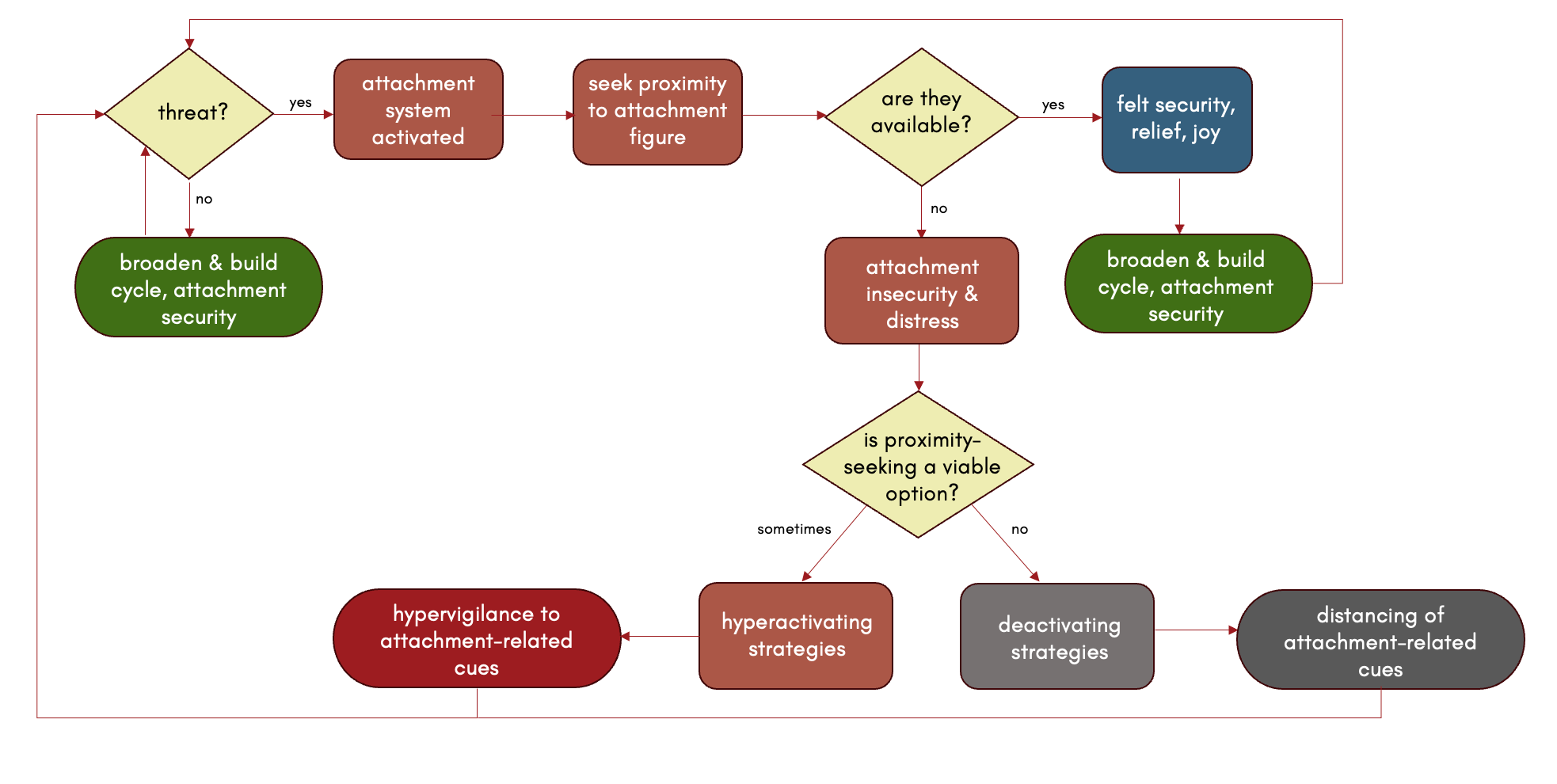
I want to look at our blue box. Felt security. Our sense that our partner is available when we need them, and our attachment needs are met, and it’s safe to go out into the green box of the world. I wonder if the blue box needs an expansion too, that a lot of the time we settle for relief, reduce the visible threat, but never quite make it to the solidity we need to truly venture out into the world, or to allow our partner to do so. We exchange our role as witness to their evolution and instead settle for being a companion to their sameness.
Familiarity is boring
We resist change in the other person by default, we take a photograph when we meet them and we edit with reluctance, or often outright refusal. We take great pride — and, importantly, security — in knowing them deeply, so when new information comes in, maybe we collapse it slightly, squish it down to make it fit what we already know. We protect ourselves from having to take a new snapshot, because what if this new person doesn’t like us? What if we don’t like them? What if we have to reveal we didn’t know them as perfectly as we thought, and our advantage is lost?
Then, a few years later, we look at them and feel very little of the excitement we felt getting to know them, because they are still just the same old person. You know all there is to know. To which I often think, do you?? Or did you just stop updating your mental model, because doing so is a risk and you want to stay safe? This is our safety drive, doing its best to protect us, but what it protects us from is the revelation of the new person our partner is always becoming, and thus from desire.
Overprotection of the bond
Sometimes (often), both partners collaborate in this project of sameness by resisting novelty altogether. We both like this board game, so that’s what we play. My partner doesn’t like horror movies, so I skip that one so we can go together. When I’ve found a bond that is precious to me, I work hard to protect it, sometimes to the point that I implicitly agree to resist novelty and evolution.
Prescriptive relationship books know this, and they tell us: branch out! Try new things! Try something on your own! And this is great advice, but like all great advice, it makes me always ask the question: why aren’t you already doing this? What is scary about it? What happened that one time you tried and your partner didn’t update their photograph of you, and they experienced your new thing as a betrayal? What happened when you subtly discouraged them from taking that course because it was scheduled on date night? Where did you get the idea that evolving was risky to the bond? And how do you unlearn that? Because until you do, all the good advice will remain yet another thing that you try for 9 days and quit.
This gets further complicated when their sameness is load-bearing for our lives.
Role collapse
The easiest way to see this is in the gender roles that we are, thankfully, doing our best to dismantle as a society right now. The overfunctioning wife, depleted and exhausted, pushing herself through one more day of appointments and housework and remembering everyone else’s needs until her husband tries to touch her and she feels disgust in response, a cue saying “I cannot serve one more needed thing today.” The dismayed husband who is doing his job to provide the home base of the family, working himself to exhaustion in his own ways, starving for connection and finding it always deferred, and then feeling blamed for his lack of contribution.
This is the classic presentation, but there are many. The person who knows how to fix the toilet, the person who facilitates the social life, the person who the cat likes when the cat doesn’t like anyone. We divide the labor of our lives in many ways, and that’s a good thing, until we feel so boxed in by our many jobs and many roles that the person is buried under forty layers of flattened roles and no one can see them anymore. Not even them.
When the life continuing to run relies on the other person staying the same, evolution is now a threat not only to the bond, but to the infrastructure. The expansion drive is permanently shut and locked. It begins to feel like the only way to unlock it is to leave the structure entirely. In some cases, it is. But I would say, with all my couple therapist bias, that’s less often than we think it is.
So far I’ve been showing you these one at a time, as though they happen inside one person. They don’t. They happen between two people, and when the threat gets loud enough, the presentations stop taking turns and start feeding each other. This is the conflict cycle, and I want to show it to you from the inside, because from the outside it looks like a fight about sex, or chores, or nothing at all.
The pressure paradox
Let’s come back to our dismayed husband, because I think we almost always look at this one from the overfunctioning partner’s point of view. Here’s what I see. This person learned the primary way of getting connection the same way we all do at first: physically. Our early attachment experiences are not words, they are entirely embodied, the warm skin of another person promises safety, food, comfort, and love. Attunement is in the parent’s touch and the infant’s full body response. Later, we learn about sex and find a nonverbal world that speaks to us on a level the verbal can never quite reach.
For many of us (not just men), that path is always the most direct. And the most dismissed, these days. I think of this guy at work, pushing through a difficult task, feeling isolated and exhausted but reminding himself this is his duty, he is the provider, this is how he makes their life go. So he does another task, and another, and inside he gets lonelier and lonelier. He starts to fantasize about that night, after the kids are in bed and the house is quiet, that maybe there will be some solace for him in the dark. He can bring whatever he’s feeling, bypass the endless words that are required of him all day, and bring his body to hers and find connection that can restore him enough to make it through tomorrow.
Then he gets told “not tonight,” or “ugh, you only ever want one thing from me” or “can we just talk?” Or maybe, if things have gone like that for awhile, he doesn’t bring it up at all. He feels the longing in his body and he puts it away for another day, trying to love her by his absence, and then we call him a withdrawer, an avoidant, a withholding husband. Verbally incompetent. Distant. Base and brutish, a monster who grunts his way to satisfaction, blissfully ignorant of the needs of a woman.
On the other side of the bed is our possibly role-collapsed, possibly hormonally-overloaded, possibly just as starved for conversation as he is for sex, woman. Trying to will herself into wanting it, applying the pressure she expects from him to herself, and finding her body on strike.
The cycle
What you just watched was not two problems. It was one loop, seen from both sides of the bed.
His threat detection reads her “not tonight” as danger, because for him the physical channel is the road home. Her threat detection reads his reach as one more demand from a world that has already taken everything, and her body answers before she can: disgust, the oldest danger signal we have. His withdrawal lands as abandonment, proof that the connection was only ever about one thing. Her distance is confirmation that bringing his longing anywhere near her is not safe. Both of them retreat to protect the bond. Both retreats read as threats. Around it goes.
The cycle does not look the same in every couple. What each partner brings to it sets the shape. Familiarity is what happens inside the loop when I stop seeing you and start seeing my photograph of you, and you resist just like that teenager did. Overprotection is what withdrawal is made of: the safety drive guarding the bond by refusing every risk, including the risk of reaching for the other person. Role collapse sets the stakes, because when your sameness is holding up the household, my safety drive is not only protecting the bond, it is protecting the infrastructure, and it will fight accordingly. The Gottmans’ four horsemen, criticism, contempt, defensiveness, stonewalling: I see all four in the loop eventually, each one a different armor for the same soft thing underneath, which is a person who wants to matter to the person in front of them and no longer believes it is safe to say so.
Bodies do stuff
I have read so many great articles lately about menopause and neuroscience and of course I cannot find them now because I forgot to save it and I can’t remember anything, for much the reasons they describe! If you’ve read or written a good one, please drop it in the comments.
Amidst every other presentation above and all the others as well, we are going through our romantic lives with a body that is doing its own thing. Hormonal drops and surges, chronic pain and illness, fatigue and depression. I could write an entire novel on these, and not as well as the many who have already done so, so let me address the part I actually have some expertise about.
Sometimes the bond is fine and our bodies just won’t cooperate. We are exploring and evolving, we bring all that expansion back to our partner and they embrace it with joy, we are madly in love, and our equipment doesn’t work. Or sex hurts. Or we’re physically depleted by an illness. In these situations, we can’t always just decide to overcome it, but we can think creatively, and couples with a strong, secure bond often do.
Sometimes the bond is not fine, and/or the individual people in the relationship are not fine. We’re unable to reach sexually until a baseline of safety is established, either in the sense of the romantic relationship being secure or in the sense of feeling physically safe in the situation. So, so many of us have sexual trauma or abuse histories, and it results in all sorts of complications to the picture.
The body, in other words, is not a separate item on the list. It is the dial that sets how easily each person’s safety drive fires, and how much room is left for anything else. Two couples can run the exact same loop, and the one whose bodies are already at capacity will hit the wall first.
The cost
Remember what passion is. Not a quantity, a rate of change: the first derivative of intimacy over time. Passion is what change feels like.
Now look at what the cycle does. Every turn of the loop is the two of you successfully preventing something from changing. A photograph stays unedited. A new interest stays untried. A role stays load-bearing. A longing stays in the dark.
The derivative of a flat line is zero.
The loop is the safety drive in action. It is very good at its job, and its job is protecting the bond, not expanding it. The only way to satisfy a safety drive is to establish a safety so deep and so true that no alarm goes off in the first place.
The passion didn’t fade, and it didn’t die, and it wasn’t traded away for safety like the bleak stories say. It is sitting exactly where you left it, on the other side of a loop that was built, with the best of intentions, to keep anything from ever moving again. Which means the way back is not date nights and novelty checklists, at least not first. It is making change survivable between you.
And not just survivable. It’s taking the two engines and getting them to run in sync. Establishing the safety of the blue box on such a deep level that exploration naturally unfolds until the new evolution of a person longs again, as we all do, to be seen, so they come home to the person who will recognize, with the full history as context, what has changed and why. That witnessing deepens the safety, opening another door for another expansion. Witnessed change is the two drives running in a loop, the way they were always meant to. Passion is what happens when they do.
The Emotional Logic is an independent, personal project and does not belong to or reflect my employer or professional organizations. Nobody’s proofreading this but me, for better or worse.
As always, bringing the science, and knocking it out of the park! Passion as the rate of change us a really helpful concept. I hear these dynamics so frequently in couples, but they don't see the patterns and don't necessarily know how to get out of them, if that's what's needed.
And, witnessed change. It's when safety doesn't lead to boredom, it creates expansion.
Love it!
"We take a photograph when we meet them and edit with reluctance." What a brilliant way to describe it. This gave me a lot to think about not just in romantic relationships, but with family (as I visit mine now), friendships, and even the stories we tell about ourselves.