

Meet the cast

I have the week off work, and I’m using it to add all the clinical material (read: actual interesting stories) to the book. You may see a few more “writing process” posts than usual.
I’m writing this to kind of get warmed up, but also because my husband made me these playlists that are so perfect I wanted to share them.
When therapists write about our clients, we usually use composites, fictional people who kind of represent a subset of the people we’ve worked with, to protect our actual clients’ confidentiality, as well as addressing some themes we tend to see as overall patterns of presentation.
I’m trying hard not to let them become caricatures, hence the playlists: they give me a feel for them as people, not just as examples. It’s also why Eli and Nadia are male/female; I didn’t want the consensual nonmonogamy couple to arrive all “Hello, we are the DIVERSITY COUPLE.”
I’m a little bit in love with my composite couples already.
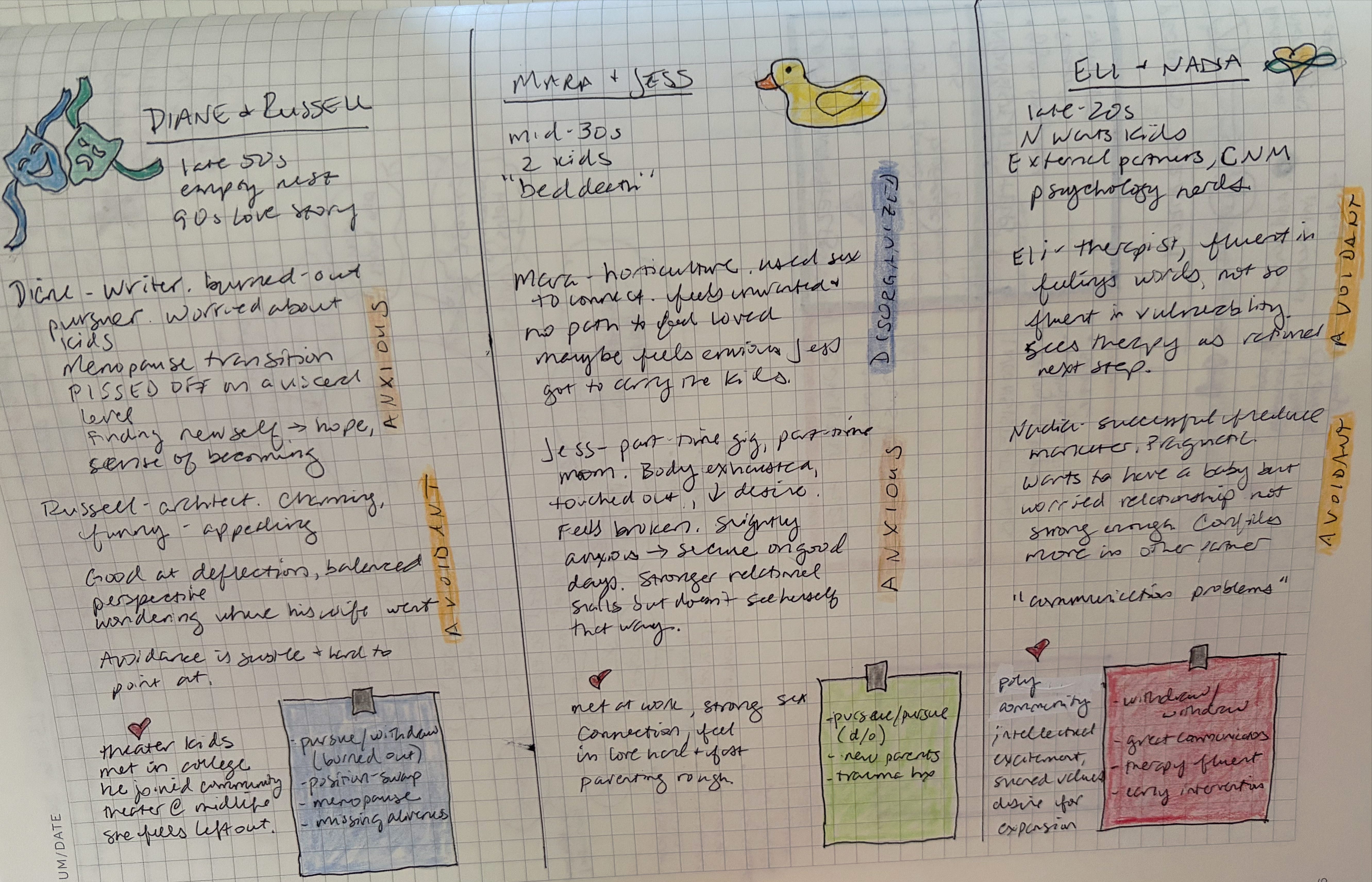
Diane and Russell are in their late fifties, thirty years married, both of their children recently gone to college. Russell is an architect, charming and socially fluent, whose warmth doubles as a method of staying at comfortable distance. Diane is a writer who spent decades as the pursuer1 in this relationship, chasing connection with a man whose avoidance was too subtle to name. She is now in menopause. She has stopped chasing. She is finding something new in herself that she does not yet have words for, and she has not brought it back to him yet. He has begun to notice her absence in a way he cannot articulate and does not like. Their story carries a pattern very familiar to couple therapists: the burned-out pursuer goes quiet (and pissed), the former withdrawer2 notices her withdrawal and discovers he has no vocabulary for what that produces in him.
Adam and I figure Diane and Russell met in the 90s - Adam’s genius addition to the playlist was the idea that most of “their” songs are his songs.

Mara and Jess are in their mid-thirties, raising two small children ages two and four. Mara carries a disorganized attachment history rooted in early abuse; sex has always been her primary register for closeness, the way she knows she is connected and safe. Their sex life has collapsed under the weight of early parenting, and Mara is reading Jess’s low desire as evidence that the connection itself is gone. Jess is touched out. Her nervous system has been in physical contact with small bodies all day and has nothing left. She is experiencing this as her own failure rather than as a somatic fact about what small children do to a body. Jess is relatively low-key pursuer (closer to the secure end of the spectrum) and Mara has a more complicated pattern. Through them, I’m writing about disorganized attachment, new-parenthood depletion, and the way sex can be the emergency alarm-bell of disconnection.

Eli and Nadia are in their mid-to-late twenties, consensually nonmonogamous, both extremely successful and fluent in the language of contemporary psychology. Eli is a therapist. He has a working vocabulary for attachment, desire, and emotional intimacy that he deploys with fluency in ways that keep him at a careful remove from actually feeling any of it. Nadia is pragmatic where Eli is reflective, but she is running her own version of the same pattern: she confides more in her other partner than in Eli and has not noticed this is significant. At a shared dinner, they each realized the people who know them best are not each other. They’re one of the examples of the drive for self-expansion in a relationship, as well as the withdraw-withdraw pattern. They’re catching it early, before it heads into “roommates” territory.

The reference posts below came over from my work newsletter, so they have slightly more self-help energy than my preferred Substack voice. :)
Why we blame

“No blaming” is right up there with “no name-calling” in the most common relationship advice books — and for good reason. Blame is hard to hear, it’s hurtful, and it is extremely likely to generate an equally unhelpful response.
Why we withdraw

It’s a familiar scene for many couples: one partner brings up a concern—maybe it’s about how much time they’re spending together or a forgotten promise—and the other partner goes quiet. The silence is heavy, the air thick with unspoken tension. Eventually, someone says, “You’re not listening to me,” and the response is a hurried “I am! Can we talk about…
Love seeing your notes!