

The right diagnosis, the wrong treatment
Elusiveness is not the smoking gun.

One of the tasks when preparing to try to publish a book is reading comps, other books like yours that are in the conversation you’re trying to enter. I’ve been reading Mating in Captivity, and (as predicted) I have thoughts.
Here’s what Esther Perel gets undeniably right in Mating in Captivity: desire is not the same thing as love. It has different needs. It requires an object - something to move toward, to want, to not quite possess yet. She’s a devastatingly precise writer, and when she argues that familiarity is desire’s natural predator, it lands because it maps onto something most people have actually felt. Even feeling about as strong in my position as I ever am about anything, I find her convincing. I don't agree with her conclusions, and I still find her nearly impossible to argue with in the moment. The hunger she describes is real. The problem is the remedy.
Perel’s prescription is distance: manufactured mystery, strategic separateness, the curated opacity of two people who refuse to fully domesticate each other. This assumes that security itself is the enemy. But the couples I’ve sat with who’ve kept desire alive over decades haven’t preserved it by keeping each other slightly out of reach. They’ve done it by remaining genuinely interesting to themselves. By using the safety of the bond as a launch pad and pushing their own self-evolution, and bringing that evolved self back to their partner. The enemy of desire isn’t security. It’s stagnation. And the difference matters enormously, because stagnation is fixable. It’s not about introducing instability into your relationship, or at least that’s not the cause of renewed desire. It is a cost, in that evolution is a risk and bringing your partner a new person to love in a new way risks that they might not like it. But I think the causal factor isn’t the instability, it’s the evolution. It’s exciting to watch a person change and grow, and to get to know them in a new delicious way after a long time of not doing so.
Perel tells the story of Charles and Rose, and it’s instructive precisely because of what she does with it. Charles begins taking other lovers. Rose, who has never been particularly interested in sex, finds herself more drawn to him. Perel attributes this to elusiveness. Rose desires what she can no longer fully possess. But Charles describes something else entirely: “When I feel erotically alive,” he says, “I don’t worry about death and I don’t worry about my age.” He’s not describing distance. He’s describing expansion, a more vivid inhabiting of himself. And what Rose is responding to, I’d argue, is the charge of that aliveness, not the sting of his absence. Perel nearly says so herself: “Each of them would have to tolerate the unfolding of the other, even if it took them beyond their range of comfort.” Tolerate. That single word tells you everything about where her frame is anchored. What if it isn’t tolerance? What if it’s the most intimate thing two people can do? Discover, together, who the other is still becoming?
I’m not saying that to reintroduce zest in one’s marriage, one has to take a lover, either in the context of consensual non-monogamy or an affair. Expansion through sex is only one of many kinds of expansion. I’ll give an example from my own life at present. A few weeks ago, I went to an externship where we trained new therapists in the Emotionally Focused Couple Therapy model. The trainer we had was amazing, and I felt so inspired, both by him and by the energy of the group, so much so that I came home and went hard on finishing the book that has been languishing in my hard drive for the past five years. I wrote for two solid days, and after that I started to notice that my clinical zest was returning. I was excited about work for the first time in awhile, as I’ve been in a kind of stagnant state myself.
I started engaging in the platform building around the book, figuring out my “brand” (gag), revising what I’d written, diving in to my clinical work with a new joy and interest, and as a result I feel myself coalescing into this new form that is still not quite fleshed out in my mind, but I can see the map of it. All of this has made me even more drawn to my husband, and I can feel him responding to me as well. I’m excited to share my discoveries with him, he’s fascinated to hear about them, and the passion in our bond evolves even as I do personally.
This is a small expansion. I’m not discovering anything entirely new at this moment, more adding depth and shading to an existing picture. But even a small expansion impacts the bond.
Muise and Goss, researchers who were most sympathetic to Perel’s concern - wondering whether she might be onto something about closeness suffocating desire - found something she didn’t predict. They set out to test whether too much closeness dampens desire. What they found, across 269 couples, was a linear relationship: more closeness, more desire.
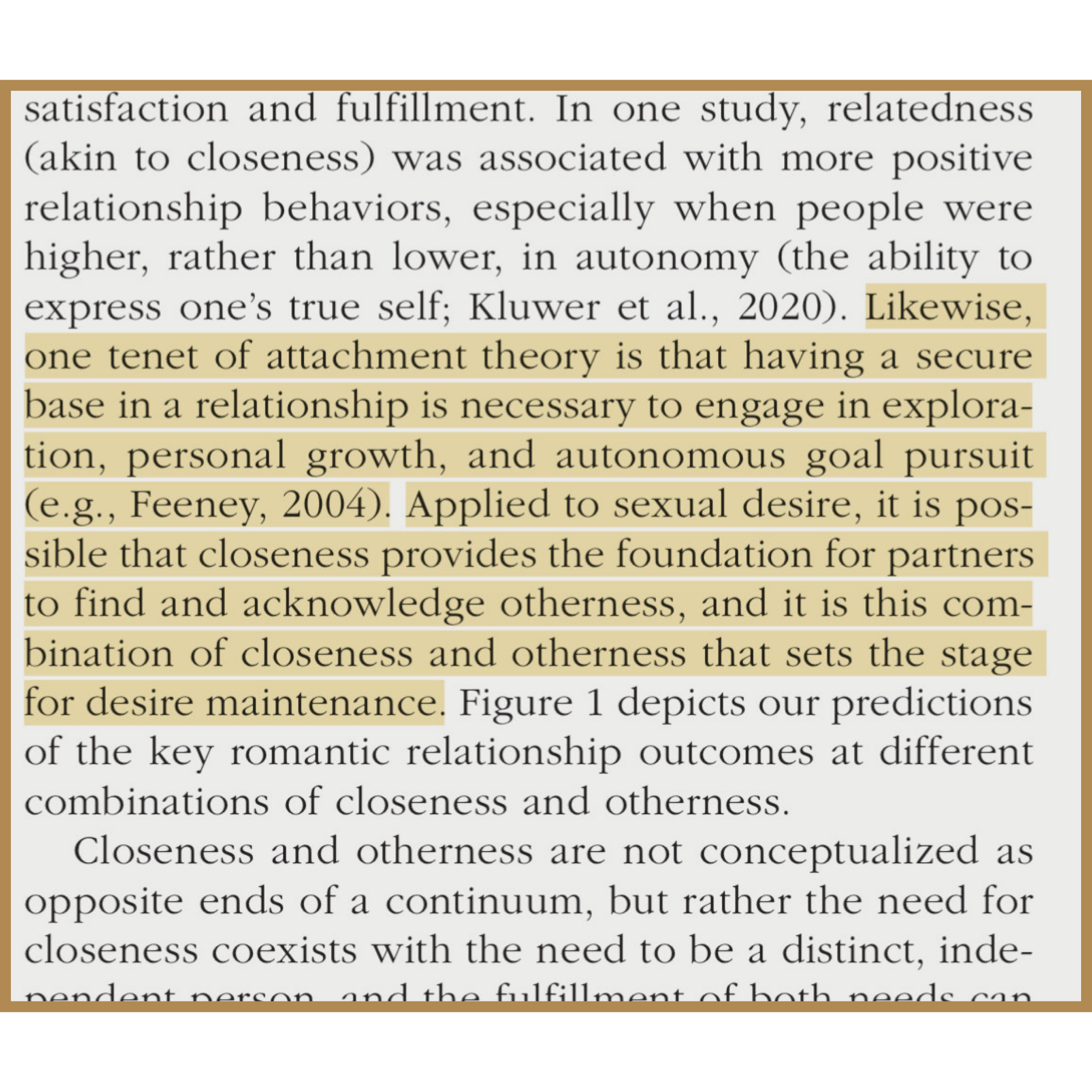
But what they found alongside that is the part I keep returning to. They introduced a construct they called “otherness” - not distance, not manufactured mystery, but the experience of seeing your partner in a new light. Perceiving them as distinct, as still-unfolding, as capable of surprising you. And across three studies, they found that self-expansion through new experiences that stretch you predicted both higher closeness and higher otherness. And both, in turn, predicted more desire.
This is what’s happening with Charles and Rose. He doesn’t become harder to reach. He becomes new to himself, which makes him new to her. Muise and Goss would call what Rose is responding to “otherness.” Perel calls it elusiveness. The difference isn’t semantic. Elusiveness is something you manufacture by pulling back. Otherness is something you generate by going forward. And, crucially, that higher closeness concept gets at what I’m getting at. The secure base is what makes expansion possible and, crucially, what makes the expanded self welcome. Our embrace of the otherness magnifies desire just as much as the otherness itself.
Perel asks: how do you want someone you already have? It’s the right question. I just think she’s looking for the answer in the wrong place - in the gap between two people rather than in the interior life of each one. Desire doesn’t need your partner to be a stranger. It needs them to be alive. And it needs you to be alive enough to notice.
The couples I’ve sat with who’ve managed this aren’t mysterious to one another. They’re interesting. There’s a difference. Mystery is something you protect by withholding. Interest is something you generate by living. And the beautiful, counterintuitive thing is that a secure bond doesn’t extinguish that. It fuels it. The people who feel safest, the most loved, are often the ones who dare to become the most.
Muise, A., & Goss, S. (2024). Does too much closeness dampen desire? On the balance of closeness and otherness for the maintenance of sexual desire in romantic relationships. Current Directions in Psychological Science, 33(1). https://doi.org/10.1177/09637214231211542
Goss, S. C., Raposo, S., Balzarini, R., Rosen, N. O., Benyamin, V., & Muise, A. (2022). Feeling close and seeing a partner in a new light: How self-expansion is associated with sexual desire. Journal of Social and Personal Relationships, 39(8), 1-29. https://doi.org/10.1177/02654075221081137
I can’t say how happy I am that I found this substack! This was such an interesting look into relationships and really made me feel better about breaking it off with my ex