

This time was different
On the space between the specific and the general

This funny thing happens sometimes in couple therapy. My couple will be telling me a story about a fight they had, and I offer an insight into the larger pattern of their conflict. This time is like the other times. This feels familiar. You almost know the script at this point, right?
And then one of them will say, “No, this was different.”
So like any marvelously attuned therapist, I go right along: “Oh, this was different. Tell me about that, what felt different?” They give more specifics: “You didn’t even call when you were going to be late. You have no consideration. I deserve better than this.”
Then I lean into that specific moment: “Right, you’re standing there looking out the window, wondering where they are, and you get mad! This isn’t fair! They didn’t call tonight, and they said they would.”
This is where the funny thing happens.
They say, “It’s not just tonight, it’s every night! It’s always like this. They never think about me. This is just like every other time.”
Part of me is always amused here. First I zoom out to the pattern and you say no, it’s specific. So I get specific, and you say no, it’s general. I’ve always thought of this as a quirk, like an evasion of me, maybe. Nothing you say gets it, no-one understands.
But something happened this week that made me reconsider my position. I was exchanging comments with a reader about that sort of transitional space between a specific instance and a larger pattern. Both of us were kind of struggling to articulate it, which is, I’ve often found, where the magic is.
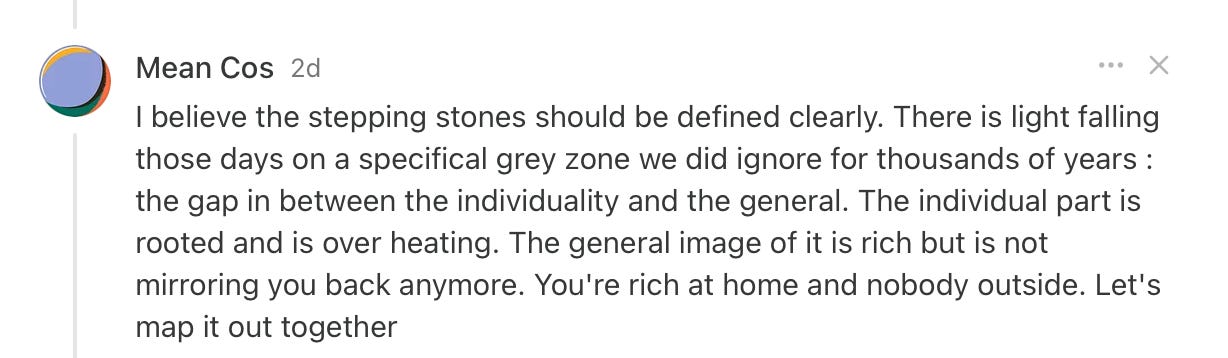
I made a quick aside in my reply about the phenomenon described above, and then I started thinking more about it. What if their objection isn’t that I’m reflecting the wrong part, what if it’s that the actual experience lives between that instance and the overall cycle of conflict?
In grad school I read a very trippy book called The Trickster Makes This World, by Lewis Hyde. One of the sentences that latched onto my brain and remains there to this day was this:
"With some polytropic characters it is possible that there is no real self behind the shifting masks, or that the real self lies exactly there, in the moving surfaces and not beneath."
Think about a performance of a piece of music. If I say “Beethoven’s fifth” I’m referring to a particular pattern of notes, one that is always the same in every occurrence. But why do people go see three different orchestras perform it? Because it’s different depending on the players, the composition of instruments, the acoustics of the hall, your emotional state in that moment, and probably hundreds of other variables. The specific instance holds all those variables. The general pattern holds none of them.
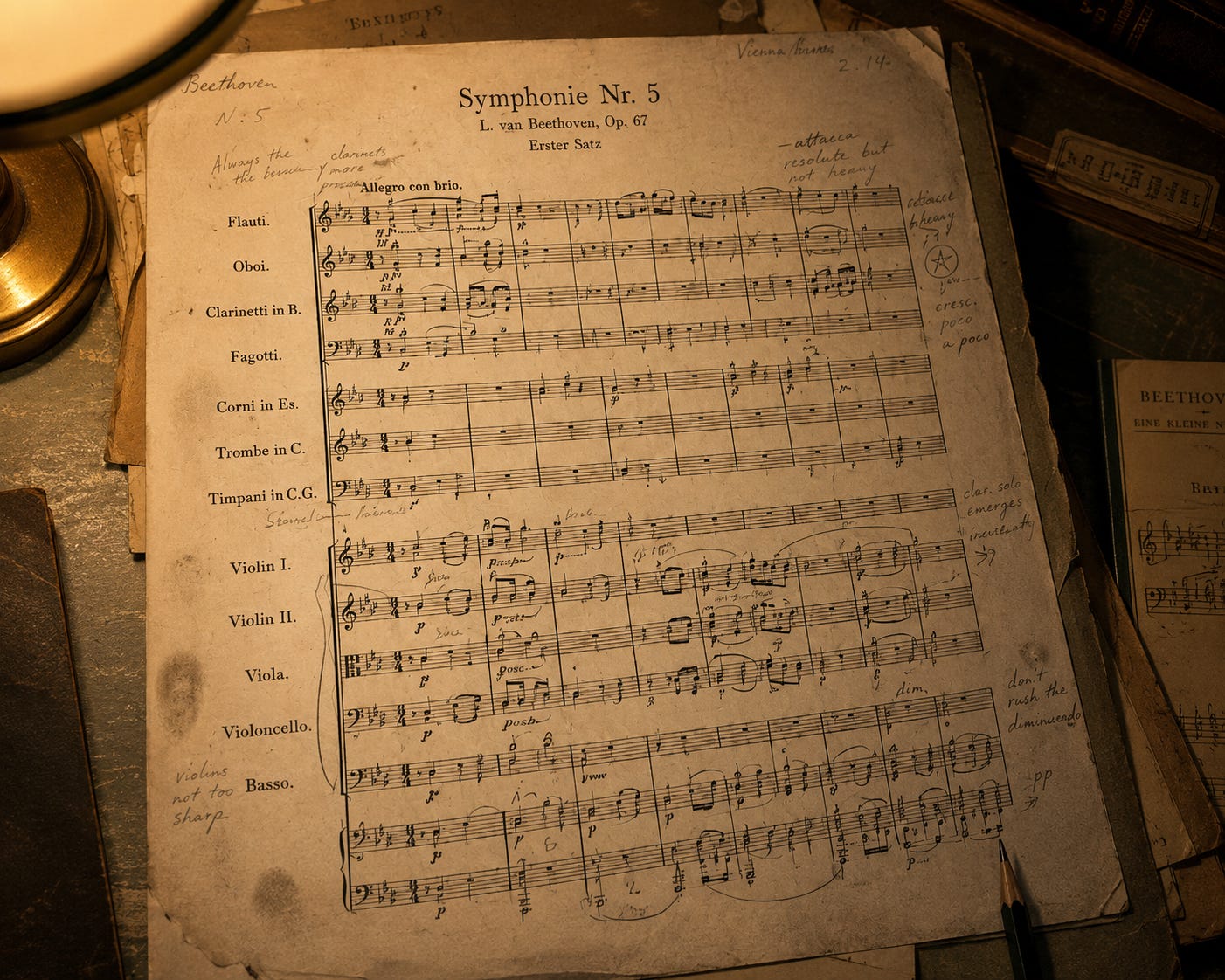
The space between.
In between you sitting in your chair on a summer night after you’ve had an excellent meal and maybe some wine, and the sheet music on the stands of the players, lives an entire world. This experience of Beethoven’s fifth is like no other has ever been, and it is the same as all the others. If I zoom out to the sheet music, or I zoom all the way into what kind of wine you had, I’m missing the experience itself: the interaction between all of those things.
When a client says, “No, this time was different,” they may be protecting something important. Not because the pattern is absent, but because this manifestation has qualities that disappear when immediately subsumed into the category.
When I move too quickly out of the specific, I miss the exact quality of their pain, the very thing they most need to be seen. When I zoom in too close to the details, I’m missing how that pain has echoes of every pain that came before it. This hundredth or thousandth repetition of the pattern feels subtly different because it has repeated so many times.
I am, in Emotionally Focused Couple Therapy terms, misattuned. And I don’t think it’s an accident, or an evasion, when I accurately reflect the specific pain of that moment, that they often zoom out on their own and point out the pattern. I ought to know more than most that when we feel met and held, it opens up the possibility of movement. “A secure base for exploration” is kind of the whole point of the book I wrote that made me start this newsletter in the first place. Maybe this is true even for conceptual exploration. I can’t see the general pattern until I feel met in the specific instance of it.
The usual therapeutic move is to assume that the truth lies beneath the surface. The specific fight is surface; the cycle is underneath. The complaint is surface; the attachment need is underneath. The anger is surface; the pain is underneath.
Often that’s useful. But our friend Hyde is pointing to a different possibility: what if the truth is not hidden beneath the surface? Perhaps it is exactly there, in the moving surfaces and not beneath.
What clients are telling me, I now think, is that I’m missing something important. This hurt arrived on this day, in this body, in this relationship, carrying the accumulated weight of everything that came before it. It is both unique and familiar. It belongs to a pattern, but it cannot be reduced to one. The fight is not just an example of the cycle, any more than a performance is just an example of the music.
Maybe the work (of couple therapy, of philosophy, of discourse, of everything) is not to choose between the specific and the general, or to reduce one to the other. It’s to stay in the between space long enough for something true to emerge. Some things may not be hidden underneath at all. They may exist only in the encounter itself: between the sheet music and the performance, between the cycle and the fight, between the pattern and its endless variations.
I still think there are truths beneath the surface. But I am less certain than I once was that they are the most interesting ones.
This makes me think of the Bothness work that Paige - Metabolizing Reality is working on. Holding the tension between two 'poles' reveals something else entirely.
'Maybe the work (of couple therapy, of philosophy, of discourse, of everything) is not to choose between the specific and the general, or to reduce one to the other. It’s to stay in the between space long enough for something true to emerge. Some things may not be hidden underneath at all. They may exist only in the encounter itself: between the sheet music and the performance, between the cycle and the fight, between the pattern and its endless variations.'