

Mechanics of Wanting, Part 1
The different faces of lost desire

It sounds like the same story, on the face of it. There’s no passion, no zing, I don’t feel the way I used to feel anymore. I don’t know if I’m still attracted to you. That’s just what happens to relationships over time, sex fades into the background. Desire is for the young—either the young in life, or the young in love.
My thought is: it doesn’t fade, it’s pushed down. It’s gated. The things that spark desire are, intentionally or unintentionally, set outside the room where the relationship is allowed to live. There are lots of gates.
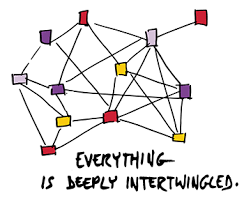
As is typical, the more I tried to write these as separate, the more they started to intertwingle.
That said, they’re not all the same exact thing, and different presentations come from different combinations of what I think of as being the underlying mechanisms. Let’s look at the presentations first, both as orientation and as honoring them for the real and distinct expressions they are.
Familiarity is boring
Being with the same person for a long time, they start to become predictable. You know what movies they like and what books they’ve read and what opinions they hold and which ones are malleable and which ones are not. You’ve had your debates and either reached a shared opinion or agreed to disagree. It feels like there is nothing left to discover, and even the conversations have gotten stale: you already know what they’re going to say next. Eventually you start to wonder if this person is even capable of surprising you anymore.
This is the most common explanation I hear, both from people and from books that Have The Answers. Everything is the same, nothing new is happening, I know all there is to know. To which my gut response is, do you?? But we’ll come back to that.
Overprotection of the bond
When we find a person that feels like a safe home base, it makes sense that we then try to protect that base at any cost. Maybe things that only one partner likes and the other doesn’t start getting done less often, in service of doing things together. Maybe anything new starts to feel like a move away from the core stable structure, and the core doesn’t feel flexible enough to receive whatever might happen and reshape itself around new information, so we start to slowly back away from novelty itself.
What happens over time is that there does start to be a sameness. No new activities or interests are allowed or facilitated, and so we just rewatch the same show or play the same game. This I think is where most advice is like, develop new interests! Find something new to do together! Make sure you as an individual are continuing to grow. And those are all good things to do, but none of them are actually asking the most important question: why aren’t you already doing this?
Role collapse
We all play a lot of roles in our lives, and as we get older, there seem to be more and more of them. Parent, spouse, child, sibling, employee, household manager. Fixer of broken things, person who makes the phone calls, person who makes the grocery list, person who handles spiders. On and on the list grows, and we get both more fatigued and more confused about where the me of it all went.
It makes sense to me that the natural outgrowth of all this confusion is a blob of undifferentiated people, none of whom feel like the real person. And the natural consequence of the blob is the question that grows louder and louder: can I even be myself in this house?
The pressure paradox
With or without role confusion, we all have points of exhaustion. When sexual pressure starts to come on in the midst of that exhaustion, it’s very easy for a cycle to begin: they ask for sex, we feel turned off, they feel neglected and hungrier for connection, they amp up the pressure, we reject harder, and so on.
And it’s not always even pressure from the other person, we can easily get into a pressure-resist loop within our own minds. I used to want sex, why don’t I? What’s wrong with me that I keep saying no? How do I say yes? Maybe I try to say yes even though I’m not all-in on it, and it’s terrible, and then the next time I’m asked (by them or by myself), my no is louder. The anxiety increases. The resistance increases.
Conflict cycles
The pressure cycle is sometimes a variant of the “main” argument, and sometimes the main argument stands on its own. One of us presses for more help, more information, more sex, more time. The other backs away, maybe feeling failure or fear of disappointment or just a need to process before responding. The withdrawal sends another danger signal, the pressing amps up in response. More withdrawal, more criticism, more defensiveness.
John and Julie Gottman talk about the “four horsemen” of divorce: criticism, contempt, defensiveness, and stonewalling. I see all 4 in the cycle, eventually, all feeding each other. Here I think is a good place to mention disgust, the emotion no-one wants to feel in their romantic bond. We feel disgust typically in situations that are dangerous: gross food that might make us sick, for example. Disgust is usually a good signal that there’s danger, either literally or in more subtle forms like “I’m all lone with task yet again.” Disgust is the early indicator that contempt is right down the road, and both are outcomes of the cycle running unchecked. And both are death to wanting.
Bodies do stuff
Here’s a huge factor that we all know but undersell at times and oversell at others. We have hormonal surges and depletion, depression, fatigue. Physical pain and illness, Weight gains and losses (which are almost never affecting the bond in the way we think they are. I’ve never dug deeper into “you’ve gained weight and I’m not into you anymore” and not found a cascade of seemingly-unrelated layers that are exerting more of an influence on desire than physical appearance). Erection issues, vaginal issues, medication side effects. There are probably thousands of symptoms that are relevant to sexual desire and expression.
There’s a lot to say about them (and I will) but for now, I’ll say this: if we think they’re the only obstacle, we’re often wrong. If we think they can just be overcome with a can-do attitude, we’re often wrong. They are related to everything else in this list. Sometimes they exacerbate other problems. Sometimes they arise from the other problems. Sometimes they wouldn’t be an obstacle to a good sex life at all, if the bond were flexible enough to work around them.
What does this light mean?
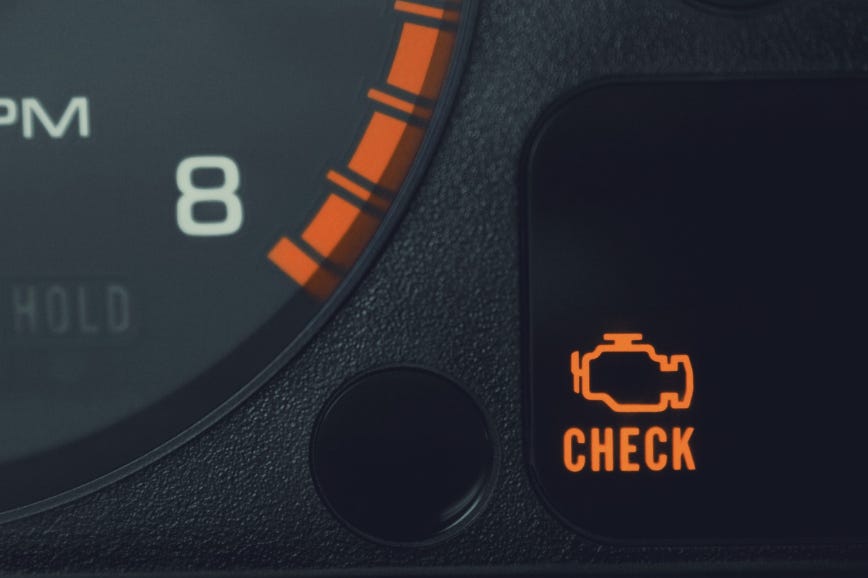
The main takeaway I want for you in all this is: when you notice one or more of these presentations, it should function as an indicator that more inquiry is needed. A check-engine light for the relational bond. None of them are an answer to why you feel less desire for your partner. They are different ways that problems show up, but in my experience, there’s something deeper that is driving each of them, often a lot of somethings, and they’re all related to each other.
The precise ratio of the underlying factors—which pressures are being exerted, which drives are active or blocked, how many are active at the same time and how—determine what shows up on the surface. But none of them are hopeless, and I think there’s a structure we can understand that both explains them and offers directions on the way out.
If you've found yourself in one or two of these, or all of them, at once, that's not your diagnosis. It's just a symptom list. Next week, we go looking for what's actually causing the symptoms.
The Emotional Logic is an independent, personal project and does not belong to or reflect my employer or professional organizations. Nobody’s proofreading this but me, for better or worse.
I really appreciated this, Andrea. Reading this as a clinician, I found myself especially drawn to your distinction between the different presentations and the underlying mechanisms beneath them. The "check-engine light" metaphor especially stayed with me. I also appreciated how often you pause to ask not simply what is happening, but what might be driving it. I'm looking forward to Part 2!
Breaking this into categories is great! I write abd talk about desire in long-term love and with women and often think of how it is very much there, but buried. And it's buried under all these categories you described...along with sometimes having never given ourselves permission to have desire at all (ie societal messaging(.