

Mechanics of Wanting, Part 2
A little monkey science, a little calculus, and the two drives running your love life.

There are two wolves drives inside you.
I wrote last week about a bunch of ways missing desire shows up in relationships. Today I’m going to talk about why. To do that, we need monkey science.
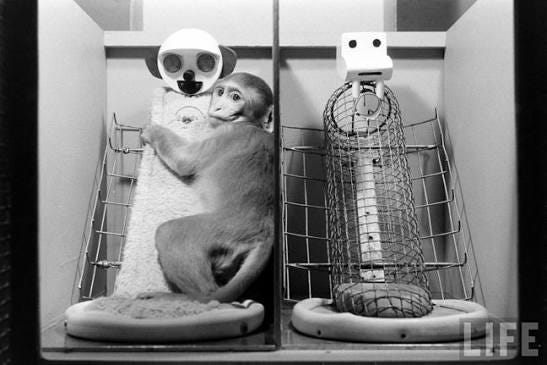
Famous monkey scientist Harry Harlow did an experiment1 where he demonstrated that the need for comfort and safety is fundamental, and that you can’t explain away babies going to parents for comfort as a by-product of the fact that parents have the food we need for survival. He cleverly did this by making two “mothers” that baby monkeys could go to: one made of wire with a feeding mechanism attached, and one with the wire covered in cloth, who was snuggly. Baby monkeys strongly preferred the snuggly mom, going to wire-mom purely for food and then returning to the cloth-mom.
Harlow’s evidence was foundational to attachment researcher John Bowlby’s claim that the attachment drive was fundamental and primary — that is, it was not secondary to the hunger drive. For the purposes of this discussion, I’m going to call it the drive for safety.
Later, at the monkey lab, Louis Moon did another experiment2, this time about monkeys looking out a window. He found that well-fed, well-hydrated monkeys who were kept in an enclosed cage chose to spend over half their time looking out a window, and that doing so was a reinforcer; they liked it. This is the groundwork for our second drive, the drive for exploration, also primary, running right alongside the drive for safety.
I came here to read about human desire, not monkey science, what are we even doing?
The two drives are the machinery that underlies the desire we feel (or don’t feel) for a romantic partner. We just need one more piece of science to fill out the picture.
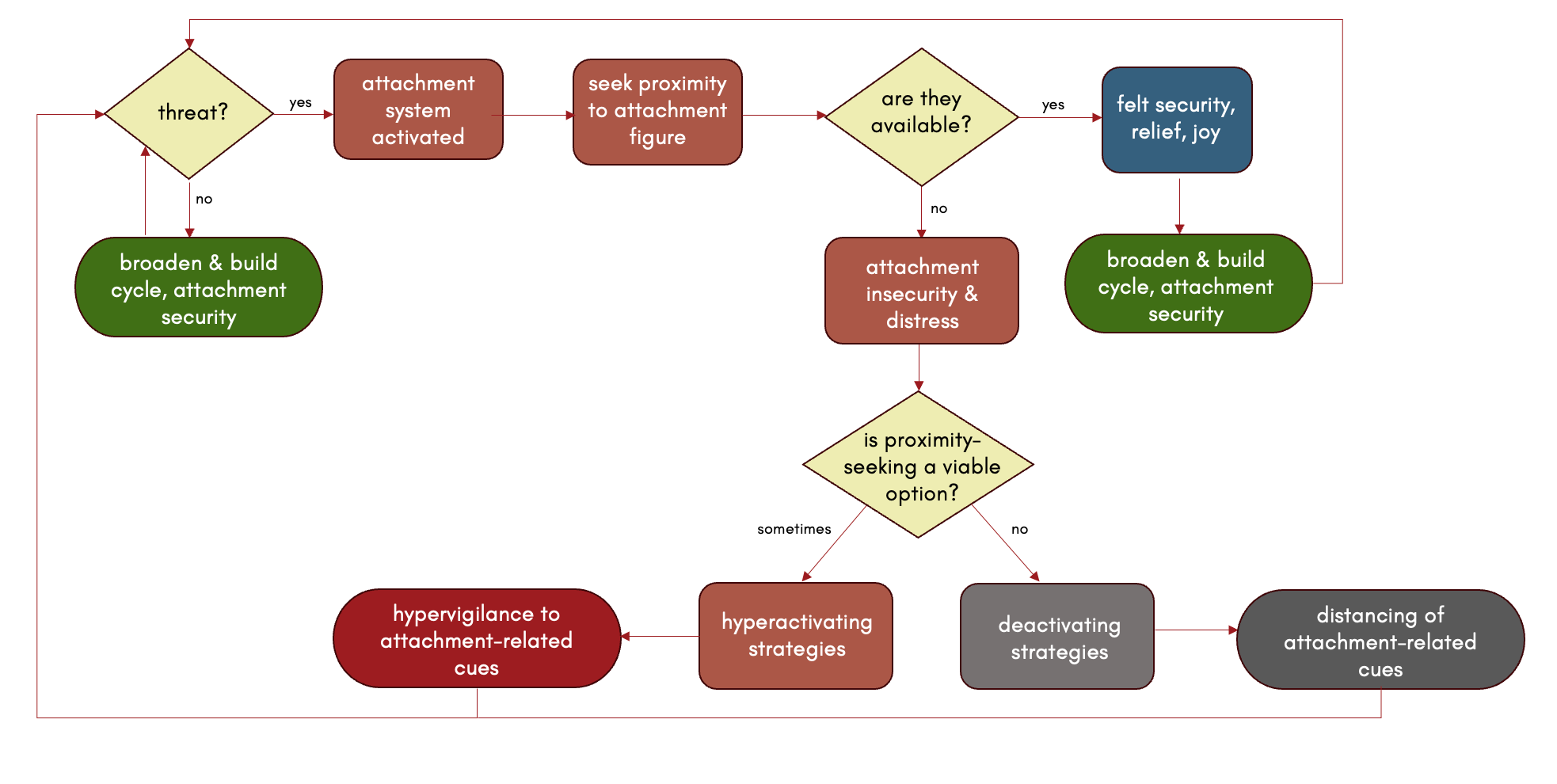
The drives operate simultaneously, but their expression doesn’t. We’re not going to get too far into the attachment system here, other than to say that it is organized around the drive for safety. The bottom half of that chart, everything that happens when safety isn’t there, is where Part 3 lives. When safety is present, it opens the door to the green box in our flowchart3.
The broaden-and-build cycle4 is our exploration drive in action: we seek out new experiences, our creativity opens up, we seek out resources and make new systems and learn new things. The attachment system’s goal is a secure base for exploration: a place we can go to retreat, and then to explore from. Safety and exploration, in a loop.
A little more science for the sapiosexuals amongst us, because this idea might be the sexiest thing to ever come out of academia. Baumeister & Bratslavsky said that passion is the first derivative of intimacy over time.5 Passion is the rate of change in intimacy, which explains why it’s so overwhelming at the beginning of a new relationship.
When we first meet someone, our intimacy is at zero. As we get to know them, it skyrockets in terms of the rate of change. 0-60 happens fast and the zing we feel at the beginning is a felt response to that change. We’re excited by the speed, and it makes us floor the accelerator hard, and intimacy zooms ahead. Later in a relationship, it slows down; the rate of change from 100-120 is slower, so it feels less intense (which is sometimes a relief). Also important to my argument is that at the beginning, our protection is low. We don’t have that much to lose yet, and the motivational system is drunk on dopamine and reducing our general risk-aversion a great deal.
The drop in rate of change is the reason people say passion fades and goes extinct. But I think it doesn’t actually fade to zero. It’s true that probably later in life passion is not going to make us fully insane the way early passion does (thank god) but we can influence the rate of change. And that brings us back to our two drives, because they have a direct impact on how much we change.
When the bond feels unsafe, we stop expanding to focus on establishing safety. Not much changes, and passion drops in response. The other thing that happens is that this person is now really important to us. We work hard to protect the bond, and sometimes that makes us resist expansion even when safety is actually present, because we aren’t sure that it is.
Too little safety and we can't explore. Too much, and we won't. Both of them cost us the same thing. Next week, we’ll look at how all this produces the symptoms in Part 1.
The Emotional Logic is an independent, personal project and does not belong to or reflect my employer or professional organizations. Nobody’s proofreading this but me, for better or worse.
Harlow, H. F. (1958). The nature of love. American Psychologist, 13(12), 673–685. https://doi.org/10.1037/h0047884
Moon, L. E. (1961). Visual exploration as reinforcement of conditioned bar-pressing responses of monkeys. Journal of the experimental analysis of behavior, 4(2), 119–123. https://doi.org/10.1901/jeab.1961.4-119
adapted from Mikulincer, M., & Shaver, P. R. (2007). Attachment in adulthood: Structure, dynamics, and change. New York, NY: Guilford Press.
Fredrickson B. L. (2004). The broaden-and-build theory of positive emotions. Philosophical transactions of the Royal Society of London. Series B, Biological sciences, 359(1449), 1367–1378. https://doi.org/10.1098/rstb.2004.1512
R.F. Baumeister and E. Bratslavsky (1999). Personality and Social Psychology Review, 3, 49-67. https://doi.org/10.1207/s15327957pspr030
Love this. There's SO much talk of safety being the ultimate goal, bit I think there is more to it, which you shared. We can experience safety as dull, boring, or uninteresting.
Passion as the rate of change in intimacy explains why stability can feel suspiciously like boredom. Long-term desire may depend less on recreating the beginning and more on continuing to discover parts of each other that aren’t already known. Apparently, love needs a secure base and occasional new material.