

You might be wrong about everything.

When I was in college, I met my longing.
I went on a date with a man named Adam, and something happened that I am still, decades later, not entirely sure how to describe.
We were in bed together, early enough in the relationship that everything was still new and slightly astonishing, and I had gone somewhere. Drifted, the way I sometimes did without quite knowing it, present in body but absent in some harder-to-name way. Dissociation is the clinical term, and I knew the term, because I was studying it. What I didn’t know, until that moment, was that someone could notice.
He asked me to open my eyes.
That’s all. Just that. But no one had ever noticed before, and no one had ever asked, and the experience of being seen accurately, in the place where I actually was rather than the place I was performing being, was so unexpected and so complete that something shifted inside me. My internal working model of what I should expect from other people had a lot to say about invisibility. About the particular loneliness of being in a room full of people looking in your direction without quite seeing you. And here, in this person who had known me for approximately seventy-two hours, was someone who saw. Here, my nervous system informed me, with a certainty that bypassed all my scientific skepticism, was the person I had been waiting for.
A few days later I was sitting in an exam and, without warning, without invitation, a memory of that moment arrived in the middle of a question about trauma. An intrusive memory, vivid and disorienting, the kind that pulls you out of the present tense and deposits you somewhere else entirely. I sat there in the exam hall, physically present but emotionally and mentally back in that dorm room, and thought: I am either in serious trouble or onto something interesting.
It turned out to be both. The intrusive memory planted a question that became a years-long obsession and eventually a dissertation: what if transcendent positive experiences are as overwhelming to the brain as traumatic ones? What if the nervous system doesn’t, at some fundamental level, distinguish between an experience that is too much in a terrible way and one that is too much in a glorious way? What if the consequences, neurologically and relationally, are more similar than anyone had thought to look?
The intrusive memory sitting down at that exam was a data point. The brain sometimes treats overwhelming positive experience and overwhelming negative experience with the same basic toolkit: encoding it deeply, returning to it involuntarily, organizing subsequent perception around it. Falling in love can exceed what trauma therapists call the window of tolerance — the range of arousal a nervous system can process without being overwhelmed — just as surely as a car accident can. The difference is that nobody sends you to therapy for falling in love, because we have collectively decided it is a good thing, and good things are not supposed to require processing.
Unless you’re me.
Adam, and the sense of possibility he carried, and the deep, certain, embodied sense that I had always known this was going to happen someday, that there was a shape to my future that included exactly this: all of that was so overwhelming that I found myself, a student in clinical psychology who was supposed to know things about the mind, genuinely wondering if I had lost mine.
I had not lost my mind (well, not totally). But I had, it turns out, temporarily lent significant portions of it to my motivational system.
The early stages of romantic love are associated with activation of the dopaminergic reward system. The same network of structures involved in the experience of reward from food, gambling, and yes, addictive substances. This is why, in the early stages of love, the pursuit of the beloved has the quality of compulsion rather than choice. You are not deciding to think about them constantly. Your reward system has decided for you.
There is also a deactivation worth noting: the regions associated with critical social judgment tend to go quiet during early passionate love. The brain, in its wisdom, temporarily suspends the faculties most likely to notice that the person you’ve fallen for has annoying habits, complicated family dynamics, and a deeply questionable opinion about a film you love. This is, arguably, a feature: the nervous system clearing the way for pair-bonding by getting the prefrontal cortex out of the room for a while.
The result of all this neurological activity is an experience that researchers describe, with admirable understatement, as “motivationally significant.” Falling in love is a significant neurological event. What it feels like from the inside is more like being slightly insane in a way that is, for once, entirely pleasant. The intrusive thoughts. The inability to concentrate. The way time moves differently depending on whether they are present or absent. The physical symptoms — the racing heart, the heightened alertness, the sensation of the world being simultaneously more vivid and less real — that seventeenth-century physician Jacques Ferrand catalogued as the symptoms of “erotic melancholia” and that modern neuroscience has confirmed are real, measurable, and remarkably consistent across cultures and centuries.
Ferrand, working in 1610 without the benefit of fMRI technology, called passionate love a disease. He was not entirely wrong. He was also not entirely right. What he was looking at was a nervous system doing exactly what it was designed to do: pursuing a potential mate with the full resources of the reward system, suspending ordinary judgment, and producing the kind of focused, relentless motivation that makes pair-bonding possible for a species whose offspring require years of cooperative care. It is just that the system, like many well-designed systems, is optimized for a purpose that is not always compatible with your comfort or your GPA (that B+ in molecular biology was worth it).
But I think there’s something else going on here.
What is the function of intrusive memories? They’re like reminders, or alarms: SOMETHING DOESN’T FIT. They pull our attention away from the status quo and onto something that is not yet incorporated into our worldview, our self-concept, our story. What trauma and early love have in common is that they destabilize us. They break the rhythm of everyday life. Trauma reorganizes us around fear. Love reorganizes us around possibility.
The possibility wasn’t just that Adam was different from other people. The possibility was that I might be different from who I thought I was. If someone could see me, perhaps I wasn’t invisible. If someone could stay present with the parts of me that disappeared, perhaps disappearing wasn’t necessary. By briefly removing my protections, it opened the door to the idea that maybe my defensive system was outdated, and the threats that it was created to manage were no longer present. The experience wasn’t merely pleasurable. It was disorienting.
The intrusive memories I experienced afterwards were a warning: YOU MIGHT BE WRONG ABOUT EVERYTHING. And that warning kept coming for me, it arrived unbidden during that exam, and several more times in the weeks that followed. It refocused my attention towards the possibility of a reorganization of myself. An expansion, yes, but also a revision.
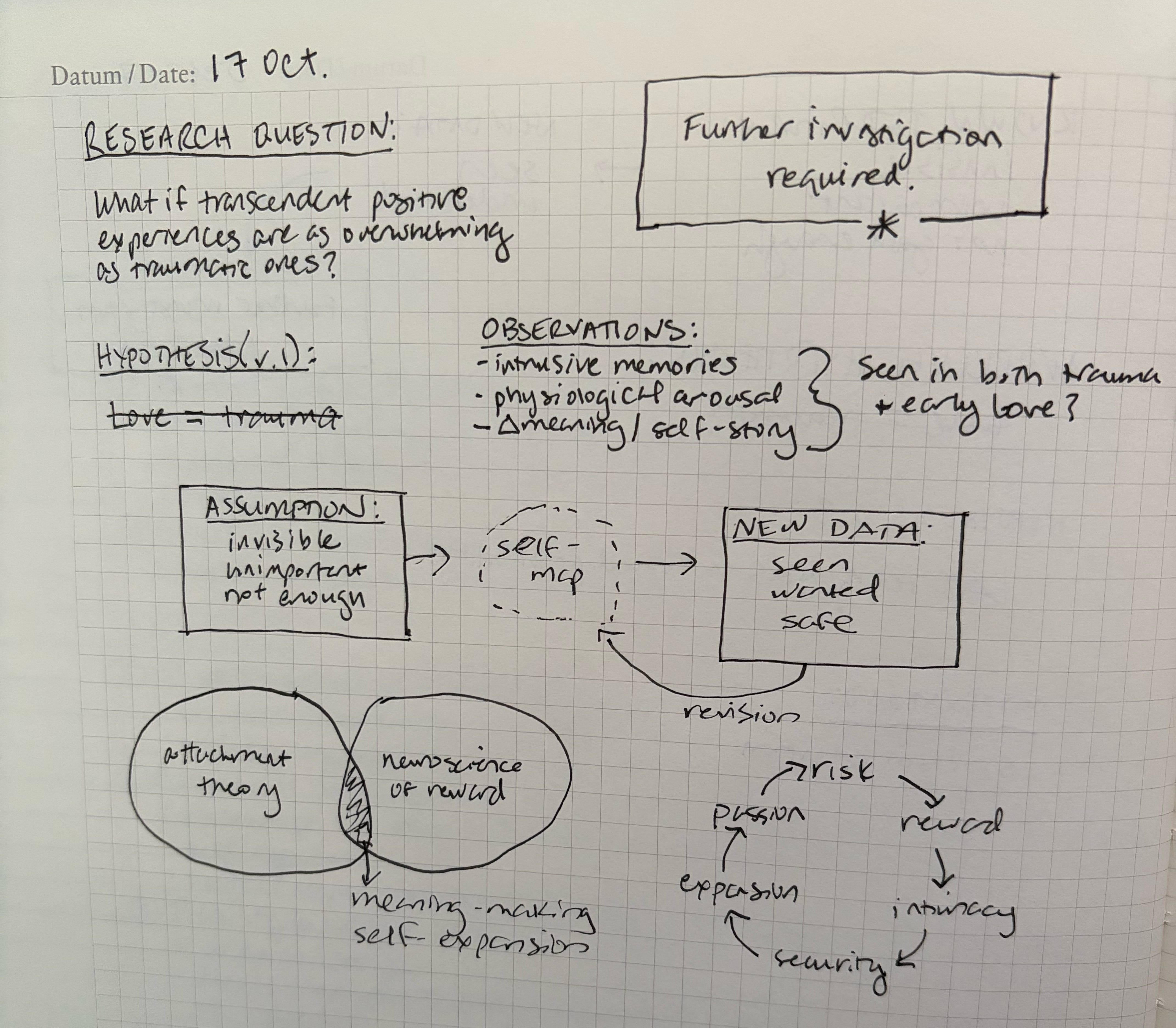
This is definitely still a hypothesis, one that has been evolving this way and that throughout my entire research career. I wrote my senior thesis in undergrad about intrusive memories and positive experiences. I wrote my doctoral dissertation about passionate love and why it makes us crazy. Now I’m writing this book about self-expansion and what makes it possible in long-term relationships. I still don’t know entirely what happened to me, and maybe that is the point. I understand it differently at every phase of my life and every phase of this relationship.
What I do know is that Adam shocked the hell out of me when he said “Open your eyes.” He surprised me enough that I did it. And then the world was different.
Aron, E. N., & Aron, A. (1996). Love and expansion of the self: The state of the model. Personal Relationships, 3(1), 45–58.
Acevedo, B. P., & Aron, A. P. (2014). Romantic love, pair-bonding, and the dopaminergic reward system. In M. Mikulincer & P. R. Shaver (Eds.), Mechanisms of social connection: From brain to group (pp. 55–69). American Psychological Association.
Fisher, H. E., Aron, A., Mashek, D., Li, H., & Brown, L. L. (2002). Defining the brain systems of lust, romantic attraction, and attachment. Archives of Sexual Behavior, 31(5), 413–419.
I always found falling in love very stressful, never enjoyed it so much. So I can relate to that.
I believe the stepping stones should be defined clearly. There is light falling those days on a specifical grey zone we did ignore for thousands of years : the gap in between the individuality and the general. The individual part is rooted and is over heating. The general image of it is rich but is not mirroring you back anymore. You're rich at home and nobody outside. Let's map it out together