The Secure Base Is for Leaving
Creating the conditions for renewable desire

A few weeks ago at a conference, I entertained a brief fantasy that I was going to somehow achieve one of my personal life goals, which is to have access to an fMRI machine. If you think this is the nerdiest goal ever, well, you’re right. But honestly, if you’ve been here for awhile, a) that shouldn’t surprise you, and b) can you think of a more exciting thing to be able to do for someone obsessed with watching what the brain does?
Sadly, cornering an exhausted presenter after a two-day conference to tell him my idea did not result in him immediately pulling out his phone and calling a grant writer, but I still want to tell you about the idea his talk sparked in me.
Jim Coan1 is a bit of a celebrity in my little corner of the therapy world, because his hand-holding studies include some of the best evidence that Emotionally Focused Couple Therapy changes the amount of safety a partner can provide. The short version is this: put one partner in an fMRI machine, tell them they’re going to receive a painful shock. They anticipate the threat with fear and report the shock hurts. Have them hold the hand of their partner, the fear recedes—maybe. If their bond is distressed, it’s less than you might expect. Then do EFCT, try again, and you see a huge reduction in threat and less reported pain. Magical!
Or maybe not so magical, but rather the expected result of having someone you can rely on. Coan's larger argument is that our brains don't treat other people as a nice bonus added to an otherwise self-sufficient system. We calculate what the world will cost us on the assumption that other people, and the resources they provide, are available. Being alone isn't really our baseline at all.
Rather fortuitously, I came back to my room from that talk and found that someone had written a very excellent exploration of Social Baseline Theory, so now I don’t have to. You can read hers instead.2
At my conference, Coan was talking about what betrayal can do to this system — he called it the “Iago effect” — and saying that after betrayal, we are a lot less likely to do what he called yielding. When a partner betrays us, it is incredibly difficult for the brain, along with the rest of us. We perceive the partner’s resources as both unavailable and threatening, and engage in a lot more cognitive effort and vigilance, producing a kind of fearful fog through which we then try to navigate the world. The mechanism that typically works to help us conserve resources and expend more efficient effort is now not available. Attachment injuries, he said, do not heal with time, because they contain crucial survival information.
This got me thinking about the inverse, and this is where it ties in with a lot of my thinking. Betrayal makes us less likely to risk yielding to another. Safety makes it more likely that we will, and crucially that we perceive that we can. When we feel safe with someone, we spend less energy monitoring threat, defending against loss, and calculating whether we can afford a risk. That freed up capacity doesn’t disappear, so what happens to it?
One possibility is that it just gets stored as extra energy to help the system run better. But what I was wondering is, what if it gets turned toward other things? What if it becomes available for curiosity, play, sexual exploration, expanded thought, increased interest and motivation?
What if safety doesn’t just restore us to baseline, but makes us risk more? If another person is part of my brain’s expected resource pool, what do I do with that freed up energy? Once again, it brings me back to the question of what is all this safety for?
If you risk reaching for your partner, and they grab your hand and hold on tight, now you are a team that faces things together, and more risk becomes possible. What I see here is a powerful recursive system, that operates in a couple of different ways that are themselves acting interdependently.
The secure base is for leaving
You can explore outside the relationship: try new things, become someone different, and experience all the excitement and inspiration of that process. Because you have that hand to hold, you are more willing to climb the next hill and see what’s over that tempting horizon. The drive for exploration is released by the knowledge that you can always come back home. This allows for the kind of differentiation (Muise and Goss’s otherness) that keeps a bond — and a life —from becoming static. We aren’t that excited by rediscovering things we already know. Desire requires encountering someone who is separate, surprising, and alive. This, I think, is where the idea that elusiveness and mystery are what ignite desire comes from. But I don’t think it is (or has to be) elusiveness. It has to be otherness. Differentiation. Exploration leads us to become someone new, and all those new qualities are very exciting.
Then you come back home, unpack your suitcase, and show your partner all the shiny things you found along the way. You let them see the new parts of yourself, and that novelty and expansion allow for a newer, faster increase in intimacy, producing the sense of passion and desire that is a measure of that rate of change. This is starting to look remarkably like a mechanism for a renewable source of novelty inside attachment.
This gets us out of the standard problem of novelty in relationship being a finite resource. If desire depends on discovering previously unknown facts about a fixed person, we’re screwed. But people aren’t fixed, and in fact the security of a reliable bond might just ensure that, by allowing the drive for exploration to run without being gated by fear.
The secure base is for staying
At the same time, our increased capacity for risk is running inside the relationship. Every time we risk revelation or need with a person, and they respond by loving us more, it makes it more likely we’ll take a bigger risk next time. The excitement of passion gives us an extra boost, returning us slightly to that rare combo of wanting and having that exists when we’re falling in love. We’re more motivated to risk more. The payoff simultaneously deepens our safety and makes us more inclined to take another risk.
What if we could risk saying that thing we’ve never said before? What if revelation of what is hidden is only possible within the context of someone who has a proven track record of welcoming every shift? What becomes possible if our freed up energy from all the safety we’ve worked so hard to build is turned toward exploration within the relationship?
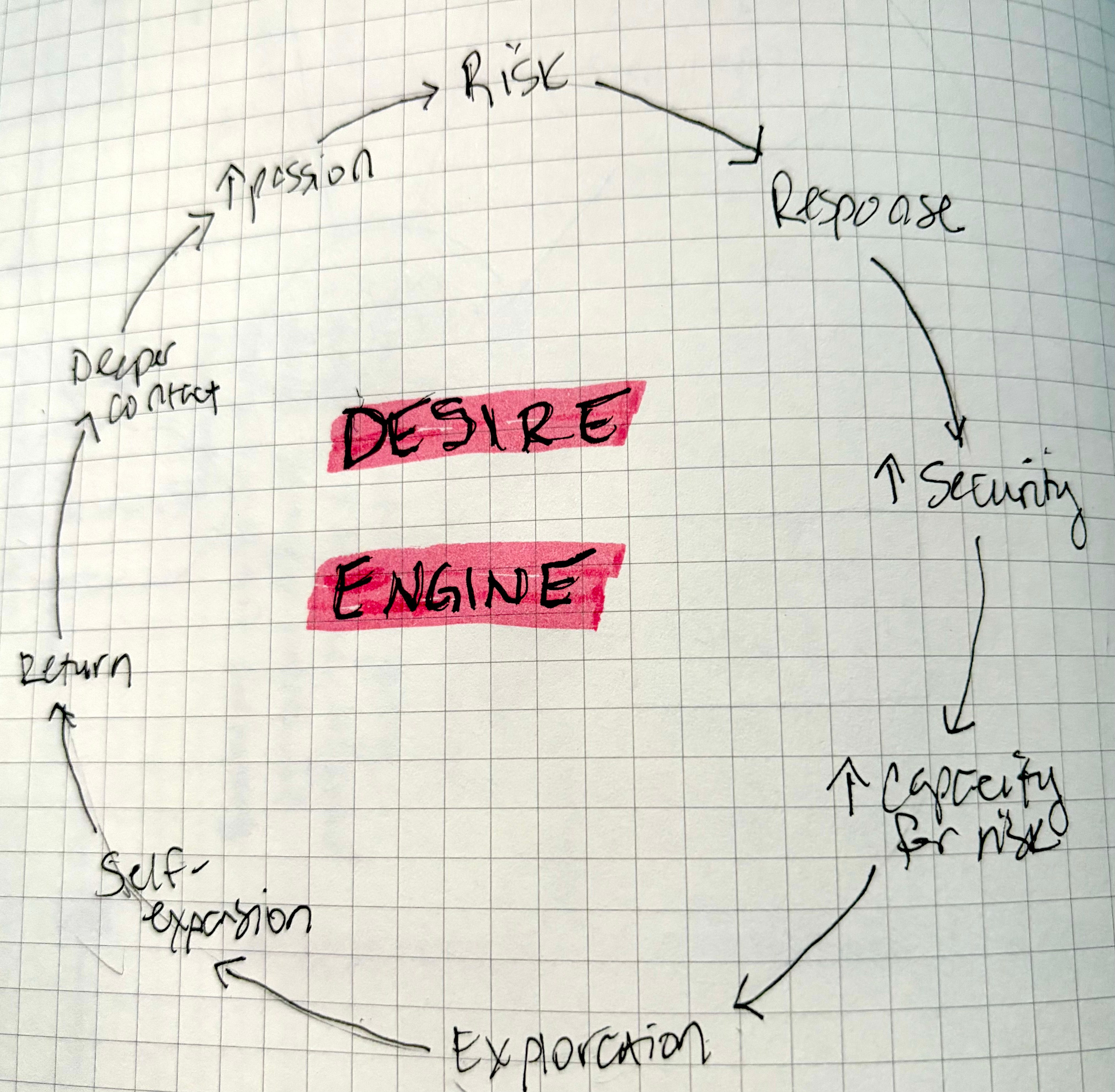
Exploration doesn’t just go beyond the front porch. It goes further into the house, to those hidden rooms we dream about sometimes, where we discover a previously unknown door off the kitchen that somehow we never noticed was there. There is unexplored territory inside the relationship: a desire I haven’t told you about, a fear I’ve hidden (maybe from myself), a way I’ve changed I’m not sure you’ll like. When I risk one of those and you meet me there, I haven’t just increased my safety and reduced my cognitive load. We’ve expanded the territory in which we can exist and explore together, making the next risk both safer to take and more tempting to try.
Safety and exploration are mutually amplifying systems.
Betrayal is devastating because it reverses the loop. I risked, security failed, exploration became more costly, I risk less, reveal less, bring less of myself into contact with you, and the relationship becomes more static. Overprotection of the bond works similarly, leading to a sameness that makes it unsurprising that we reached the incorrect conclusion that familiarity kills eroticism. What really happened, I think, was that the exploratory loop stopped running.
Attachment gives us safety. Exploration gives us novelty. Therefore, we’ve concluded, long-term love is a balancing act that requires us to somehow reconcile two opposing forces. But what if they’re not opposing at all? What if they have always worked best in concert, the secure base for exploration fulfilling its purpose by allowing an endless deepening of safety that produces capacity for ever-expanding exploration?
I feel like that’s a pretty interesting idea. Who wants to give me an fMRI machine?
Ana Lund on Social Baseline Theory
The Emotional Logic is an independent, personal project and does not belong to or reflect my employer or professional organizations. Nobody’s proofreading this but me, for better or worse.